

This handbook is focused on policies, procedures, and information for you as a student, whether undergraduate or graduate. New and revised policies are published as they are approved. Please direct any questions about the handbook to [email protected].

The faculty are charged by the CU Board of Regents with responsibility for the quality of education of each individual student. Inherent in this responsibility is the assessment of individual progression based on both academic and professional standards.
Any student may be subject to immediate Suspension, Dismissal, or Expulsion when in the judgment of the faculty, in consultation with the Associate Dean of Academic Programs, Dean of CU Anschutz Nursing, and other appropriate CU officials, the safety and welfare of CU, the public, and/or patients warrant such action. No student shall be suspended, dismissed, or expelled without the opportunity to petition through the Student Affairs Committee (SAC), except in those situations that involve allegations of violations of local, state, or federal law, which do not fall within SAC purview.
Grounds for Suspension, Dismissal, or Expulsion include but are not limited to, demonstrable behavior contrary to ethical and professional nursing standards, neglect of clinical responsibilities, impairment in classroom and clinical settings due to drug and/or alcohol use, poor academic performance, or violation of the standards of conduct established by the CU Board of Regents.
The purpose of this policy is to provide a mechanism to request a review of a course failure or other situations affecting program progression. If the final course grade does not affect program progression, refer to Grade Appeal Unrelated to Progression Policy for instruction. The Ombuds is also available as a confidential resource to help students access the appropriate office or means of resolving a problem. Additionally, if the issue does not involve a grade failure or progression, the student may also go to the Associate Dean of Academic Programs or the Assistant Dean of Undergraduate or Graduate Programs for assistance.
Course failures are appealable if the failure impacts program progression and (a) faculty deviated from or erroneously applied established criteria for evaluating academic or clinical performance as outlined in policy and procedures, course syllabus, or related course documents or (b) student believes faculty harassed, discriminated, or retaliated against them. If the student files a claim of harassment, discrimination, or retaliation with the Office of Equity, program progression will be paused and the grade appeal will not be processed until a decision by the Office of Equity is rendered.
When course failure appeal criteria are met, and if the student and involved person(s)/faculty are unable to resolve the concern, the student may file an appeal with the Student Affairs Committee.
In the event of two concurrent course failures, each appeal hearing will be heard separately to allow for an independent appeal hearing process. This will include different voting SAC members participating in each hearing, if feasible.
If the student decides to appeal two concurrent course failures, the student will be required to suspend program progression until the SAC renders a decision. Subsequent progression is dependent on the SAC decision and may involve an interruption in the student’s original plan of study or withdrawal from the program.
1. Informal Resolution Requirement
Before an appeal is submitted students must first seek an informal resolution with the faculty of record by taking the following steps:
2. Appeal Process
The student obtains the Appeal Request Form from the Assistant Dean of their respective program and submits the completed form within five (5) working days of the course failure. Submission of an Appeal Request Form initiates the formal appeal review process.
Within 5 working days of completing the Appeal Request Form, the student may provide any supplemental materials relevant to the appeal.
The SAC chair in coordination with the student’s program Assistant Dean will schedule the appeal hearing. SAC will coordinate the appeal date with all involved parties including the faculty member of record. An appeal hearing will include at least three voting SAC members. Non-voting members and the faculty of record/involved parties may also be present. Every effort will be made to schedule the SAC hearing within the ten (10) working days of the submitted Appeal Request Form
Prior to the appeal hearing, all involved parties and SAC committee members will receive electronic copies of the appeal and supporting materials for their review.
3. Appeal Hearing
During the appeal hearing, the student may have an advocate of their choice be present with them, but the advocate may not speak on behalf of the student. Appeal hearings may include SAC student representatives unless the student initiates the appeal requests otherwise.
During the appeal hearing, the student and the faculty/involved parties will be given equal time (10 minutes) to address the committee and may remain in the appeal to hear all information presented. The SAC members in attendance may ask questions of the student and faculty/involved parties for an additional 10 minutes.
Once the voting SAC members have concluded their questions, the student and the involved parties will be excused from the appeal hearing while SAC members deliberate. It is the responsibility of the SAC members to execute a final vote and decision regarding the SAC appeal hearing. Ex officio and non-voting members may participate in the deliberations but do not vote on the outcome.
The possible recommendations/outcomes of the SAC appeal hearing are as follows:
Any of the above outcomes may result in an interruption in the student's program plan, thus delaying student progression and graduation. The SAC chairperson will inform the Associate Dean of Academic Programs (or designee) of the appeal decision.
The Associate Dean of Academic Programs in collaboration with the SAC chairperson or designee, and the appropriate Assistant Dean (Undergraduate or Graduate) will inform the student of the final SAC decision by letter using the student’s CU email address within five (5) working days.
This decision is final unless the student is suspended or dismissed from the program or college. Refer to Suspension and Dismissal Policy.
4. Process to Petition for Academic Progression
In the instance that a SAC decision results in program or college suspension or dismissal, the student has a right to appeal to an ad hoc committee overseen by the Dean’s Office. The chair of SAC will convene an ad hoc committee of three (3), one of whom is a CU Anschutz College of Nursing faculty from a similar program (undergraduate/graduate) and has not previously interacted with the student while in the academic program. The ad hoc membership is approved by the Dean. One member of the ad hoc committee will be chosen as chair and will record the committee meeting.
a. The student must prepare a written statement for the ad hoc committee’s consideration.
b. As a part of this appeal, all information, notes, and documents submitted to the SAC will be shared with the ad hoc committee and the student.
The student may not bring forth additional information unless new information, not available at the time of the SAC hearing(s) has become available.
c. If the student’s suspension or dismissal is not related to a SAC decision, any
documentation retained by faculty, involved parties, or the student related to this action will be shared with the ad hoc committee.
d. The hearing will be attended by the ad hoc committee of three (3), the Associate Dean of Academic Programs,
and the Dean of the Anschutz College of Nursing. The ad hoc committee may invite CU Anschutz College of Nursing involved parties, including but not limited to course faculty, clinical faculty, specialty director(s), and academic advisor, as indicated after reviewing the submitted
materials. The student will be permitted to bring an advocate during the hearing, but the advocate may not speak on behalf of the student.
e. The committee will determine the length of time the student has to present their appeal. After
the student presents, the student is excused, and the ad hoc committee will deliberate and make a recommendation to the Dean of CU Anschutz College of Nursing who makes the final decision in conjunction with the Associate Dean of Academic Programs.
Possible recommendations of the ad hoc committee are as follows:
The instructor is responsible for the grade symbol assigned. Special symbols (e.g., “NC,” “W”) are indicators of registration or grade status e not assigned by the instructor. The grading system allows the use of plus/minus grading at the discretion of the program/instructor.
Letter Grade | Grade Scale | Percentage |
A | 4.0 | 94-100% |
A- | 3.7 | 90-93% |
B+ | 3.3 | 87-89% |
B | 3.0 | 84-86% |
B- | 2.7 | 80-83% |
C+ | 2.3 | 77-79% |
C | 2.0 | 74-76% |
C- | 1.7 | 70-73% |
D+ | 1.3 | 67-69% |
D | 1.0 | 64-66% |
D- | .7 | 60-63% |
F | 0 | Less than 60% |
I Incomplete, regarded as “F” if not completed within one year*.
IP In-progress coursework at the professional level; thesis, project, research, rotations only at the graduate level.
P/F Pass/Fail, P grade is not included in the grade point average; the F grade is included and included in the grade point average.
NC Indicates registration on a no-credit basis.
W Indicates withdrawal or drop without credit.
Note: Students in the Baccalaureate program are expected to maintain a minimum grade of “C” in all courses (a grade of “C-“ is not acceptable). For all graduate degrees in Nursing, the student is expected to attain a minimum grade of “B-” in all required Nursing courses. A grade of “B-“ is acceptable, but not as a grade-point average overall. A “3.0” GPA, which is equivalent to a “B” (not a “B-“), must be maintained overall in order to progress in the program.
An “I” is an incomplete grade. The student must request the incomplete grade when extenuating circumstances have arisen. The instructor may or may not grant this request. Once granted, the student must complete a contract with the faculty of record when the original ‘I’ was issued, outlining the work required and the time frame for completion. If the student does not complete the work for the ‘I’ course satisfactorily within a year, the grade posted will be an “F.”
The final grade (earned by completing the course requirements or by retaking the course) does not result in deletion of the “I” grade symbol from the transcript. A second entry is posted on the transcript to show the final grade for the course. At the end of one year, “I” grades for courses that are not completed will be regarded as “F.”
Students may obtain grades from the UCDAccess website. Revised 1/14/09; Implemented 1/30/09; Approved by General Faculty, 12/16/13
Final course letter grades are calculated and submitted to the registrar based on whole numbers. A minimum standard of rounding in all courses is necessary to provide consistency and transparency to students. Only the final course grade that represents the completion of all coursework will be used for rounding purposes.
The calculated final course grade will be rounded using the number in the tenth position after the decimal of the final grade calculations. Final course grades of 0.5 and higher will be rounded up to the next whole number. When the number at the tenth decimal place is less than 0.5, the grade is rounded down to the next whole number. For example, a final course grade of 87.52% will be rounded up to 88%. A final course grade of 87.49% will result in a final grade of 87%.
Implemented 8/2020
Exams and quizzes provide a measure and assessment of a student’s progress towards course outcomes. A minimum threshold of achievement is necessary to establish a reliable measure of competence towards developing a complete knowledge base that leads to competent and safe nursing practice. Students must achieve a 74% cumulative minimum average on all proctored exams and quizzes to pass the course. Dosage calculation quizzes/exams are not included in the 74% cumulative minimum average requirement. This applies to all courses (including online and hybrid) in the undergraduate program except those that do not have proctored exams and quizzes.
To pass a clinical course, students must pass clinical (on-site and off-site) AND meet the 74% cumulative minimum average on all proctored exams and quizzes (does not include dosage calculation quizzes/exams). Failure to achieve one or both requirements result in a final grade earned of “F” even if the cumulative score on all course assignments/assessments is greater than 74%.
If proctored exam scores are weighted, the weighted exam scores will be used to calculate the cumulative minimum average. Raw exam scores are not rounded. Additionally, the cumulative exam average is not rounded.
To determine the 74% weighted cumulative exam average, use the individual exam percent score multiplied by the weight of the exam divided by the total weight of the exam(s) for the class. For example: exam 1 score earned is 89% and is weighted as 25%; exam 2 score earned is 87% and weighted as 25%; final exam score earned is 74% and weighted as 30%. To calculate the weighted cumulative exam average, the computation is (89 X 0.25) + (87 X 0.25) + (74 X 0.30) = 66.2. This score would then be divided by the total weight of the exams: 66.2/0.8 = 82.72. 82.75 is the weighted cumulative exam average; this is not rounded, and thus the weighted cumulative exam average is 82%.
In non-clinical courses, if a student does not meet the 74% cumulative minimum average on all proctored exams and quizzes, a final grade earned of “F” is recorded even if the cumulative score on all course assignments/assessments is greater than 74%.
Academic progression is the continuation of the academic program based upon an approved, sequenced plan of study. Students are responsible for successful completion of all degree requirements and are expected to work with an advisor to ensure that satisfactory
progress is being made throughout their academic career.
Undergraduate Requirements
All requirements for the undergraduate nursing degree must be completed within 5 years from the time the student matriculates to
the Anschutz College of Nursing. Failure to successfully complete degree requirements within 5 years may result in dismissal from the College of Nursing.
Leaves of Absence do not extend the 5-year time period. An extension may be granted of up to
one year for good cause or in extenuating circumstances. Any extensions to the 5-year degree completion time limit must be approved by the Associate Dean of Academic Programs.
Master Requirements
Master’s degree
students are required to complete all degree requirements within five (5) years from the semester of their admission and the start of coursework, regardless of full-time or part-time status. Failure to do so may result in academic dismissal from their
program. Students facing extenuating circumstances can petition the Associate Dean of Academic Programs for an extension. Petitions must have the endorsement of the student’s Specialty Director and, if granted, may extend the time limit by up
to one year. In some cases, students may be required to repeat didactic coursework or clinical practicums.
Good academic standing in the baccalaureate program requires a minimum 2.0 cumulative GPA, no incomplete grades, and a minimum earned grade of ‘C’ in all courses. Graduate students are required to maintain a cumulative GPA of 3.0 or better, with no incomplete grades, and a course passing grade of “B-“or better in all courses. Students who fail to meet these standards are subject to the College’s academic probation and suspension policies. Students on probation or suspension are not considered to be in good academic standing.
Students who are not in Good Academic Standing may not (a) participate in clinical/internship experiences, healthcare-related volunteer activities as a CU Anschutz Nursing student, or doctoral practicum experiences (affiliation agreements indicate a letter of good standing is required), (b) self-identify as students for any health care- related volunteer activities, or (c) represent themselves as active nursing students in public or clinical settings.
The parameters defining full-time and part-time status for students at the Anschutz College of Nursing are as follows:
Undergraduate
- Full-time: 12+ credits/term
- Half-time: 6-11.99 credits/term
- Less than Half-time: 0.1-5.99 credits/term
Graduate*
- Full-time: 5+ credits/term
- Half-time: 3-4.99 credits/term
- Less than Half-time: 0.1-2.99 credits/term
*Students enrolled in at least 1 credit of Thesis or Dissertation courses (e.g. NURS 8990) are considered full-time.
If students currently living in Colorado or additional states where CU Anschutz College of Nursing meets licensure requirements choose to move to a state where CU Anschutz Nursing does not offer a program that meets licensure requirements, the College of Nursing will not be responsible for the inability of a graduate to apply for licensure in that state. Prior to moving, please see the campus SARA website for additional details on state compliance.
The purpose of the Comprehensive Examination is for learners to demonstrate their mastery of the terminal outcome competencies of the CU Anschutz Nursing Master’s program. Additionally, it provides an opportunity to engage in scholarly dialogue with CU Anschutz Nursing faculty and peers on critical issues in nursing or midwifery.
Deadlines For Completion of Examination
Format for presentation
PMHNP, AC-PNP, PC-PNP, FNP, WHNP, AG-CNS, AG-ACNP, AG-PCNP, Midwifery
i-LEAD, HCI, VMHC
Upon completion of the Comprehensive Examination, consensus among Faculty and/or examination committee members (at least two) is required to determine the outcome. Success is assessed through three potential outcomes:
Pass
Conditional pass, with stated conditions
Fail
The Specialty Director will inform the learner of the outcome of their Comprehensive Examination. Additionally, the Senior Enrollment Advisor will be notified to potentially update the student's matriculation plan, and the Graduate Program Manager will be notified for record-keeping purposes.
Course attendance is a critical element of CU Anschutz Nursing’s Professional Role and Behavior Policy. Students should reference that policy to determine course attendance requirements.
CU Anschutz Nursing has established strong, collaborative relationships with a significant number of clinical agencies for the purpose of securing appropriate clinical placements for its students. However, due to the limited availability and dynamic conditions related to student clinical placements, students must demonstrate flexibility to complete the clinical/internship portion of the curriculum.
Approved academic plans of study are provided to students during the orientation process by the Office of Academic Programs shortly after program admission. Students are to register for the courses in the sequence as outlined on their Plans of Study. Graduate clinical placements are established by the Graduate Specialty Director and the Graduate Placement Office. Undergraduate student clinical schedules and placements are communicated by the Experiential Learning Team approximately one week prior to the start of the course/clinical. It may become necessary to change clinical schedules and placements (i.e., days, times, and locations) due to changes required by the clinical agencies. Additionally, the Experiential Learning Team/Graduate Specialty Directors may provide some students with clinical placement information later or earlier than other students. In rare situations, undergraduate students may be required to complete a different clinical course than originally scheduled in their Plan of Study due to sudden changes in clinical placements and in order to avoid a delay in academic progression or graduation.
Occasionally, students may be required to attend class or clinical during academic break periods, weekends, intersession periods, or Spring Break as a result of clinical agency requirements. Clinical shifts may include day shift or night shift. Intersession is considered the time between scheduled semesters. In general, students are not required to attend class or clinicals on official holidays or during intersession periods noted on the CU Anschutz Nursing Academic Calendar. However, there may be situations in which students are required to attend clinicals on official holidays or intersession periods in circumstances when completion of clinical hours is necessary to prevent delays in students’ academic progression or graduation.
Undergraduate clinical schedules, mandatory agency orientations, and any changes to clinical schedules or agency orientations are communicated to students by the Experiential Learning Team as soon as the information is available.
To the extent possible, child care, other work schedules, and commitments should be arranged around on-site and off-site clinical orientations and schedules. Pre-approved religious accommodations will be honored. Additional planning and flexibility may be required by students should a clinical schedule or agency orientation change abruptly. It is advised that traditional undergraduate students maintain a maximum of twenty (20) flexible, unscheduled hours per week to accommodate for potentially changing schedules. Students in the Accelerated (UCAN) program are strongly advised not to work while in the program. Clinical orientations and on-site and off-site clinical schedules will not be changed to accommodate employment schedules.
All students are responsible for maintaining current clinical/internship requirements, including, but not limited to, immunizations, CPR, HIPAA, and OSHA, in order to practice safely in the clinical/internship environment. Additionally, students must be prepared to submit agency-required clinical documents as soon as notified of a clinical placement. Delays in either of these things may result in the forfeiture of a clinical placement. When a clinical placement is forfeited, substitute clinical placements cannot be assured, and this may result in delayed academic progression.
Although clinical/internship placement decisions are made with consideration of a student’s location/residence, it is important to note that clinical/internship arrangements may be made anywhere along the “Front Range” and within the state of Colorado. Students must demonstrate flexibility to attend the clinical agency identified for the student placement and must have reliable transportation to travel to clinical sites. This may include traveling several hours from the Denver Metropolitan area. CU Anschutz Nursing recognizes clinical accommodations only when approved through the Office of Disability, Access, and Inclusion in conjunction with CU Anschutz Nursing.
Revised by UCD Legal 12/22/2020; Approved by SAC 9/18/18; Implemented 9/18/18
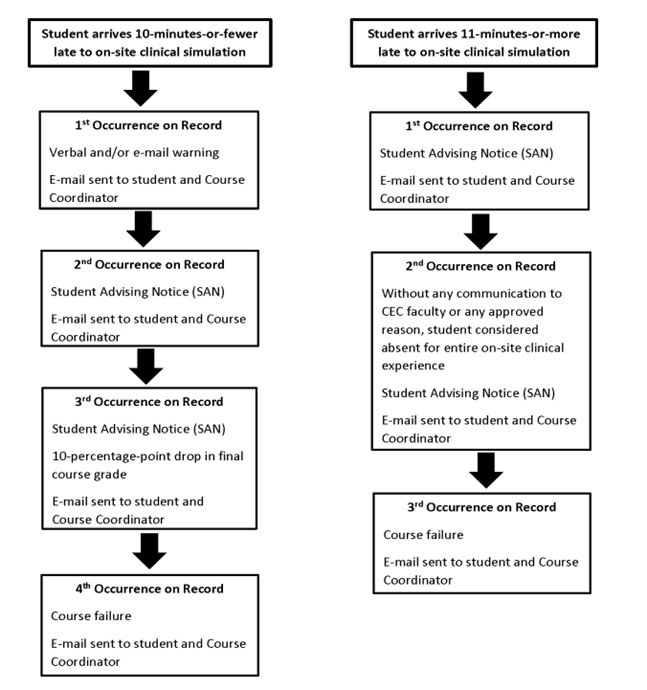
Punctuality is an expected professional behavior of all CU Anschutz Nursing students. See the CU Anschutz Nursing Policy Statement for Professional Role Behaviors (PRB) for a definition of “punctuality.” The purpose of this policy is to describe what constitutes “attendance” in the on-site clinical setting and to advise students and faculty of the appropriate, consistent consequences of tardiness and absence. This policy does not address absences or tardiness in off-site clinicals.
Students may appeal a tardiness or absence event at any level of occurrence. An appeal must be submitted via email to the CEC faculty member and course coordinator within two (2) working days of receipt of email notification of the tardiness or absence event. Appeals submitted after two (2) working days will not be considered. The appeal will be reviewed by course faculty with input from the Director of Admissions and Student Affairs and the Assistant Dean of Undergraduate or Graduate Programs. A decision regarding the appeal will be communicated to the student via email within two (2) working days of receiving the appeal. Decisions regarding the appeal will be final.
Offsite Clinical Make-Up:
Offsite make-up hours may be considered for missed clinical time (please refer to the Student Handbook for definitions of approved and unapproved absences). All clinical hours within each clinical course are required to be completed per the Colorado State Board of Nursing Baccalaureate program requirements for clinical time.
Make-up of offsite clinical hours will be considered on an individual basis in conjunction with course and clinical faculty. In some cases, make-up time will not be available due to the nature and amount of missed clinical hours. An absence of greater than 25% of the total offsite hours in a course may not be eligible for make-up. In these situations, options regarding program progression will be discussed with course and clinical faculty in conjunction with the Assistant Dean of Undergraduate Programs and Specialty Advisor or Academic Advisor for undergraduate programs.
As a first option, every effort will be made to reschedule off-site make-up time within the student’s assigned clinical agency in collaboration with the Clinical Placement Team and course faculty. Should clinical make-up time not be available within the student’s assigned clinical agency, a plan for make-up time will be created based on a variety of elements including the clinical competencies for the specific clinical course. Make-up hours may include one or more virtual simulation (vSim), and/or focused time in the offsite or onsite Clinical Education Center (CEC)) clinical setting. Off-site make-up hours are determined at the convenience and availability of the clinical agency.
For Immersion and Community Health Nursing courses, clinical make-up time will be considered on a case-by-case basis in consultation with course faculty and the Clinical Placement Team.
Students are required to attend the clinical make-up time as scheduled in order to meet course and program outcomes. The use of an alternative offsite clinical site (i.e., a clinical site different from the student’s original offsite clinical site), as a part of clinical make-up time may require students to travel within the Denver metro area. In addition, weekends and night shifts may also be used as make-up time.
Please refer to the Onsite Tardiness and Absence Policy in the Student Handbook regarding consequences for tardiness and absences in the onsite clinical setting.
Virtual simulation (vSim) may be used for make-up of onsite or offsite clinical time. The maximum amount of simulation make-up time is 10% of total clinical hours per course, using the established ratio for onsite hours per course (2:1 or 1:1). VSim cannot be used for more than 2.5% of the total clinical hours in the undergraduate program; this equates to approximately 3 vSim assignments for the entire program (including those hours completed before an interruption in the original program plan).
The use of vSim for make-up time is cumulative throughout the program. For example, if a student uses vSim for make-up of onsite hours, and later uses vSim for the make-up of offsite clinical time, the total of these two vSim assignments will count toward the maximum 2.5 % vSim utilization for make-up time for the total program clinical hours.
Make up time in the off-site clinical setting will be evaluated using the course clinical evaluation tool. Make-up time in the CEC setting will be evaluated using course outcomes. Successful completion of make-up hours and required competencies are determined in collaboration between the course and clinical faculty. Failure to complete the vSim assignment satisfactorily will result in the student needing to re-submit the assignment in order to complete the clinical requirements for the course. Unsuccessful completion of offsite make-up hours may result in a clinical failure with subsequent course failure.
Process for off-site clinical make-up hours
Process for on-site clinical make-up hours
General Guidelines for Make-Up Time
Approved off-site clinical absence: Any verifiable illness, emergency (i.e., life-threatening personal or family emergency), legal proceeding or military duty requirement may be considered an approved absence in collaboration with course and clinical faculty. Work or other personal commitments (for example planned vacations or recreational activities) are not valid reasons for absence. Documentation may be requested from course faculty to verify the reason for the absence.
A student may not independently arrange an alternative clinical assignment with a clinical agency. (See Undergraduate Clinical Make-Up Policy).
Unapproved off-site clinical absence: Any (a) missed clinical for a reason other than reasons listed in approved clinical absence or (b) lack of timely notification (prior to scheduled off-site clinical time) to the clinical scholar/instructor AND agency preceptor is considered an unapproved absence.
In collaboration with the course and clinical faculty, an unapproved absence may result in the initiation of a Student Advising Notice (SAN) or a failing grade for clinical. Clinical failure will result in failure of the course. (See Undergraduate Clinical Make-Up Policy).
Clinical education is a central component of Master of Science (MS) programs and requires careful coordination among students, Specialty Directors (SDs), and the Clinical Placement Team. The following policies outline expectations related to clinical placement assignments, supplemental clinical learning opportunities, and relocation considerations. These guidelines are designed to support high-quality learning experiences, ensure compliance with regulatory requirements, and promote timely academic progression. Students are responsible for understanding these requirements and planning accordingly to maintain flexibility in scheduling, travel, and licensure needs.
Graduate clinical placements are determined and approved by the track Specialty Director (SD) in collaboration with the Clinical Placement Team. Placements are designed to optimize student learning and may include experiences outside the Denver Metro area, throughout Colorado, and/or across multiple agencies within a single semester. Clinical experiences may also include required intensives—defined as concentrated clinical learning experiences completed over a short, defined period of time (e.g., several consecutive days or weeks)—and may occur between academic semesters. Students are expected to maintain flexibility in both scheduling and travel. Placements within the Denver Metro area are not guaranteed and are subject to availability.
Students are encouraged to proactively discuss their clinical learning needs with their SD months in advance of the semester. Students who decline an assigned clinical placement or schedule for any reason will not be provided with an alternative placement. In such cases, the student assumes full responsibility for securing an appropriate clinical placement, which must be approved by the SD and coordinated with the Clinical Placement Team. Declining a placement may result in delays in academic progression.
Students residing outside the Denver Metro area (defined as Denver, Arapahoe, Adams, Douglas, Jefferson, Boulder, Broomfield, Elbert, Gilpin, Clear Creek, and Park counties) assume primary responsibility for identifying potential clinical sites and preceptors. Students are encouraged to collaborate with their SD to ensure proposed sites align with program learning objectives. Those seeking placements outside of Colorado must be familiar with applicable Board of Nursing regulations and must initiate this process at least four months prior to the clinical experience. Some states impose additional fees for students enrolled in out-of-state programs; students are responsible for these costs. Additionally, the CU Anschutz College of Nursing may not meet Board of Nursing requirements in all states.
Final approval of all clinical sites and preceptors rests with the SD and is based on student learning needs, site suitability, and preceptor availability. Prior to the start of any clinical practicum, the SD must provide written approval, and the Clinical Placement Team must complete and submit all required documentation to the clinical agency (e.g., affiliation agreements, letters of good standing, and attestations).
If a student residing outside the Denver Metro area or outside of Colorado is unable to secure a preceptor or clinical site, the student may be required to complete clinical experiences within the Denver Metro area or elsewhere in Colorado to support timely progression. In some cases, students may also be required to complete additional clinical hours in Colorado to allow for direct observation and evaluation by CU Anschutz College of Nursing faculty or the SD. In either of these circumstances, students must hold a Colorado nursing license or compact licensure and are responsible for arranging their own housing and transportation. These requirements may impact planned academic progression.
CU Anschutz College of Nursing Specialty Directors (SDs) and faculty recognize that valuable, competency-based learning can occur through specialty clinical conferences and, in some cases, through specialty-focused continuing education, professional development programs, hands-on workshops, and other structured learning activities.
To ensure consistency and academic integrity across all graduate specialties, the following standards apply to these supplemental learning opportunities:
For all NP specialties (ACAGNP, ACPNP, AGPCNP, FNP, PMHNP, PCPNP, WHNP) these alternative learning hours may not be applied toward the minimum required direct patient care hours, in alignment with appropriate regulatory bodies.
For educational or professional development activities occurring outside of CU Anschutz College of Nursing, students must submit a written request to their SD in advance. The request must include:
The SD will review and approve or deny the request. Approved hours must be documented in the InPlace™ system in accordance with SD guidance.
Moving to the Denver Metro Area: Advanced Practice – Direct Care
Students must reside in the Denver Metro area (defined as Denver, Arapahoe, Adams, Douglas, Jefferson, Boulder, Broomfield, Elbert, Gilpin, Clear Creek, and Park counties) at least six months prior to the start of clinical.
Failure to meet any of these requirements may result in loss of guaranteed placement. Students may be required to secure their own clinical site or experience a delay in academic progression.
Moving to the Denver Metro Area: Indirect Care (iLead, HCI, VMHC)
Failure to complete these steps may result in delays to practicum or internship placement.
Moving Out of the State of Colorado or Out of the Denver Metro Area: Advanced Practice – Direct Care
Students planning to move out of Colorado or outside the Denver Metro area must inform their SD, Admissions and Student Affairs, and the Clinical Placement Team at least six months prior to relocation.
Failure to inform the SD, Admissions and Student Affairs, and the Clinical Placement Team may result in removal from the program in accordance with State Board of Nursing regulations.
Moving Out of the State of Colorado or Out of the Denver Metro Area: Indirect Care (iLead, HCI, VMHC)
Failure to notify CU Anschutz Nursing as required may result in program removal per State Board of Nursing policy.
Implemented 4/2026
The purpose of this procedure is to provide students with a mechanism to request review of grade decisions within the Anschutz College of Nursing. If the grade affects progression and meets the appeal criteria, then the student has the right to appeal to the Student Affairs Committee (SAC).
If a student is dissatisfied with a grade earned on an assignment or for a course, but the grade does not affect progression, the student’s first step is to speak privately with the involved faculty member about the grade. The faculty should provide the student with an adequate rationale for the grade given. The decision of the faculty member is final.
Created 8-10-15; Approved By General Faculty 9-28-15; Implemented 9-28-15
CU Anschutz
Education II North
13120 East 19th Avenue
3rd Floor - Room 3255
Aurora, CO 80045
303-724-1812